|
1959 - The Uttoxeter Challenge Cup is won at Oldfields. Rocester 9 Uttoxeter Amateurs 0 Back: Byron Davies (Chairman); Monty Fox; Noel Hooper; Bernard Bullock; Eric Harrison; Billy Harvey; Harry Metzner; Jack Madden; Brian Walker; Joe Carpenter; Ken Harrison (Treasurer); Gordon Mellor (Secretary). Front: Frank Hitchen; Maurice Jones; Jim Bloor; Jack Harvey; Peter Walker; Charlie Swanwick (Trainer). |
The History of Rocester Football Club Part 4 - County Leaguers (1957-1984)
After so much success in the Stafford Amateur League the club looked for a new challenge, and gained entry into the Staffordshire County League (North) in time for the 1957-58 season, which marked the beginning of a 27-year association with that league.
A highly respectable third place was achieved in the first season, but the highlight of the campaign was winning the much-coveted May Bank Cup at the first attempt. Victories over Northwood Rangers, Knutton Rangers, Park Hall and Michelin paved the way to the final where Port Vale ‘A’ awaited on Friday 31st April on the J & G Meakins ground in Hanley.
April had been an extremely busy month for Rocester, and the final against Port Vale was their twelfth match in just 26 days. Vale had hammered Rocester 8-0 the previous Saturday and were the obvious favourites to win the cup, however a super-human effort from the whole team and a solitary goal scored by Eric Ault turned the form book upside-down and Rocester won the cup.
The May Bank Cup was retained in 1958-59 when Wolstanton United were beaten 1-0 in the final, and the Uttoxeter Cup was also added to the trophy cabinet following a 9-0 destruction of neighbours Uttoxeter Amateurs in the final, which was played at Oldfields.
A fine run in the Staffordshire F.A. Junior Cup almost provided a third piece of silverware for the season. Audley, Knutton Rangers and Fenton Amateurs were all well beaten as the team cruised through to the Northern Zone semi-final where they were drawn away to Leek Town, who at that time were playing in the Manchester League.
A terrific performance saw Rocester record a magnificent 5-1 win; Frank Hitchen, Brian Walker (2), Tony Wain and Geoff Shenton netting the goals that earned a place in the Northern Zone Final against Wolstanton United which was to be played under the floodlights of Stoke City's Victoria Ground - the first time a Rocester team had ever played under floodlights. |

|
It proved to be a memorable evening for the five bus loads of Rocester supporters who travelled up to the Potteries for the game. Tony Wain (2) and Brian Walker scored the goals in a fine 3-0 win which put Rocester through to the overall final against former Stafford Amateur League rivals Stone St. Michaels.
Stoke City's legendary manager Tony Waddington came into the dressing room after the game to congratulate the team, and, in reference to Brian Walker's bullet-like shot for the last goal asked; "Where's the lad who scored that third goal? I've never seen a goal like that before!"
Despite a brave performance in the final which was played on Stafford Rangers’ Marston Road ground, Stone St. Michaels, who had won the Southern Zone of the competition, deservedly took the cup with a 4-2 win.
Although the semi-finals of both the Uttoxeter Challenge Cup and the May Bank Cup were reached in 1959-60 the club had its first barren season for eight years, and that set the trend for much of the 1960’s with only the odd cup success breaking up a series of mediocre seasons.
The most notable achievements were beating a strong Milton United side 3-1 in the 1961 County League Cup Final - Ivan Ash, Ray Morley and Peter Walker scoring the goals - and thrashing Cheadle Town 8-0 in the 1962 Uttoxeter Cup final, with Brian Walker netting four of them.
In 1961 the County League (North) was split into two Divisions (A and B) - the aim being to form two new Divisions (1 and 2) the following year from the highest placed teams. Rocester had a poor season however, finishing 10th in the 11-team Division A, which wasn't high enough to qualify for the newly formed Division One and were placed into Division Two for the 1962-63 season.
A third-place finish at the end of the 1962-63 season was good enough to earn promotion to Division 1, but despite the success on the field the club suffered a financial loss over the season. |
A rare action picture taken on the old Mill Street ground sometime around 1960. The Rocester player taking a shot and the opposing team remain unidentified. Can you name them? |

|
Club Treasurer George Jefferey presented the balance sheet at the A.G.M. in July 1963, and pointed out that poor weather conditions during the winter had resulted in gate money falling by £12; Supporters' Club memberships had fallen by £14; while the cost of transport had risen by a further £19 to a total of £134. Referees fees, insurance and administration costs had all increased on the previous season, being £428, but the club had managed to finish "well on the credit side".
In thanking the Treasurer, Chairman Ken Green informed the meeting that the Committee was now running a Bingo Club and membership was increasing. A Field Day had also been organised with a friendly match against Waterhouses F.C. in the evening. It was hoped that those two events would more than cover the loss made during the previous season.
Having won promotion the club expressed a need for several more experienced players if they were to operate successfully, but the step up a level proved difficult and after just one season the team were relegated back into Division 2 for the 1964-65 campaign after finishing second-from-bottom with just eleven points from 26 matches.
The team was beginning to decline and Rocester became a mid-table side for the next four seasons until a further dip in results saw the team finish the 1968-69 season at its lowest ebb for many years - third from bottom in Division 2.
After that season of struggle the club's future was put into some doubt when almost the entire team broke away to form a new club in the village called Springfield Old Boys.
To the eternal credit of the small committee, the playing staff was very quickly replenished and the first team completed the following 1969-70 season in a highly creditable fourth place - one point and one place ahead of Springfield Old Boys. |

|
Tony Croft was among Rocester's most prolific goal scorers throughout the 1960s.
During the course of the 1962-63 season he netted 44 goals, which included six against Bamfords in a Uttoxeter Cup tie, seven in a 12-1 league win at Newcastle Town, and another six against Stafford Colliery.
In addition, he scored four more hat-tricks that season. |
Saturday 27th October 1962 GOAL SPREE FOR ROCESTER
Rocester hit top form in their away match with Newcastle Town on Saturday. Newcastle were completely outplayed in all departments, and Rocester took full advantage of their chances to hammer the home side by 12-1.
Newcastle's defence was slow-footed and without an answer to the incisive raiding moves of Rocester's five man attack, with Hitchens, Jones, Croft and the Walker brothers playing havoc with the home defenders.
The scoring started in the first minute, Croft banging the ball home.
Four minutes later Jones picked up a rebound on the edge of the box and crashed it in. A minute later Hitchens made it three and Croft added two more to bring the score to 5-0 after only 15 minutes' play. |
Newcastle's consolation goal came after 20 minutes, when Sutton, their centre forward, the only Town player to worry the Rocester defence, put a good shot past Swanwick.
Rocester hit back and from Brian Walker's well taken corner kick Hibberd made it 6-1 from fully 25 yards before Peter Walker and Croft brought the half time score to 8-1.
With the help of a strong wind Newcastle improved a little in the second half, but still couldn't stop the goals totting up.
Jones had a block buster pushed out by keeper Howell. It rebounded to Peter Walker, who crashed it home.
Centre forward Croft scored three more before the end to bring his contribution to seven.
All the Rocester side played well, but special mention must go to centre half Roy Morley and seven-goal Tony Croft. |
The reserve team also exceeded all expectations by winning three competitions - the Leek & Moorland League Division Two title, the Division Two Subsidiary Cup and the Leek Post Charity Shield. The second string were only denied a fourth trophy after the Leek & Moorland League Division One champions Cellarhead United beat them 4-1 in the League Cup Semi-Final.
Minor adjustments to the structure of the County League during the 1970 close season saw the re-naming of Divisions One and Two as the Premier Division and Division One.
Building on their fourth place finish, further improvements to the team were made and the 1970-71 campaign brought the first league championship trophy for fifteen years back to the village. Rocester topped Division One of the County League after taking 36 points from their 22 matches - six points clear of nearest challengers Kidsgrove Athletic.
However, promotion to the Premier Division produced serious problems for the team, and when the first season in the top flight ended Rocester found themselves firmly rooted to the bottom of the table with only nine points gained from the 22 matches played.
Relegation was avoided thanks to the restructuring of the league, but interest in the club appeared to have reached an all-time low and it was recorded in the club's minute book that just one spectator from the village attended the 3-1 home defeat against Rists United in November 1971.
Despite a poor season on the field the 1971-72 club accounts showed a turnover of £910.70p (which included just £15.27p from gate receipts) and a "healthy" balance of £176.44p in the National Westminster Bank.
The committee remained active behind the scenes and were trying to move the club forward with a number of plans. During the summer of 1972 club officials met with their counterparts from the two other football clubs based in the village - Springfield Youth Club and Springfield Old Boys - to discuss an amalgamation, with the aim being to create one successful community club. |

|
1965-66 - County League Division Two Back: Ken Green; Tony Briddon; Mick Smith; Graham Dixon; Peter Swanwick; Tony Croft; Ray Woolley; Gilbert Egerton. Front: Jack Harvey; Roy Morley; Brian Ferneyhough; Peter Walker; Keith Carnwell. |
Talks went well and the plans to merge went ahead smoothly and fairly quickly. Rocester were now able to field sides in both the Premier Division and Division Two of the County League, along with an Under-18 team which was entered into the Leek & Cheadle Youth League.
Running a junior team enabled the club to make use of the facilities at Springfield Secondary School with the proviso that training sessions were run under the tutorship of a qualified coach, and this was quickly arranged.
Another result of the amalgamation was the appointment of Alf Blood in June 1972 as first team manager - Mr. Blood had been in charge of the Springfield Old Boys team.
Work also began on a bathroom extension to the pavilion after running water had been laid on for the first time, but the task had been undertaken by people from within the club and took many months to complete.
One project that failed to come to fruition was the purchase of a new ground on land bounded by Mill Lane, the River Dove and 'the cut', which was owned by local butcher Mr. Holmes. The club offered to buy a section of the land but Mr. Holmes was only interested in selling the whole 8½ acres at an asking price of £6000.
Undeterred, the committee decided to pursue their interest and co-opted the village cricket club and bowling club in a bid to create a sports centre on the site.
Grant applications were made but failed to produce the necessary funding after the Parish Council backed plans by the Rocester Playing Fields Committee to erect a general purpose building in the village rather than the Football Club's proposals.
This setback soon proved to be irrelevant when the project was dropped as soon as it was discovered that the land was classified as "wash" land, and as such could not be re-surfaced or built upon.
Some fifteen years later the club returned to Mr. Holmes and purchased the same piece of land from him for £12,000, and during the summer of 1987 made it their new home.
Back on the field, and following a slow start to the 1972-73 season results began to steadily improve.
Little time was wasted in appointing Geoff Shenton as Manager in May 1973, and the new boss was offered a cash incentive of £10 for every trophy won by his team on top of his expenses. Shenton's reign got off to quite a good start, and his team ended the calendar year by beating league leaders Leek Town Reserves 1-0 to go third in the table.
The next game, played on Saturday 5th January 1974, saw West Midlands College visit the Mill Ground, and things were looking good for Rocester after 30 minutes of play when Paul Glover received the ball some 30 yards out and beat three tackles before scoring a fine individual goal.
The young College team from Walsall managed to force an equaliser on the stroke of half-time, but midway through the second period Mick Richardson met Brian Ferneyhough's corner with a bullet header to restore the lead, and the 2-1 win propelled Rocester to the top of the table for the first time in many years. |
||
|
1970-71 - County League Division One Champions Back: Alan Smith; Keith Hibberd; Peter Swanwick; Barry Hulton; Marion Nawrot; David Tideswell. Front: David Evans; Mick Ratcliffe; Steve Brewster; Barry Thwaites; Leon Hibberd. Team captain Kenny Leese is missing from the photo. |


|
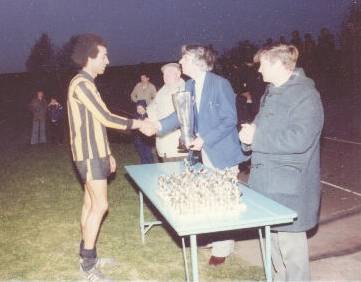
Above left - Captain Barry Hulton receives the County Premier League Cup in 1980 following the 2-1 victory over Clayton Park. Back in the village (above right) Secretary Gilbert Egerton, Hulton, Alan Smith and Chairman Ken Green proudly display the trophy. |
Hopes were high within the club that a serious title challenge could materialise, but the players were quickly brought back down to earth in their next fixture against Michelin Athletic Club, who handed the new league leaders a 3-0 thumping up in the Potteries.
A 2-1 win over local rivals Uttoxeter Town maintained the pressure on the Reserve teams of Stafford Rangers and Leek Town at the top, but after two more points were dropped against Blythe Matthey and only a 1-1 draw was achieved at struggling Red Cow, the league title had slipped out of reach. Nevertheless, ending the season in fourth place was no mean achievement, and represented the club's highest finish in fourteen years.
Over the next decade, under the management of Bob Bassett and then Alan Smith, the club firmly established itself in the Premier Division, always finishing in the top half of the table but falling short of being able to mount a truly serious title challenge.
Cup football however, proved to be a completely different matter as the growing Rocester team reached no less than eight cup finals between 1976 and 1980 – but winning just three of them.
Those three successes came in the 1976-77 and 1979-80 Premier League Cup competitions when Baddeley Green W.M.C. (3-1) and Clayton Park (2-1) were beaten, and in the 1978 Uttoxeter Challenge Cup when Uttoxeter Town were easily dispatched 4-0 at Oldfields. |

|
Friday 28th April 1978
Uttoxeter Challenge Cup Final
Uttoxeter Town 0 Rocester 4
Rocester coasted to victory at Oldfields in one of the most one-sided finals in the history of the Uttoxeter Challenge Cup.
Uttoxeter Town, despite the home advantage, were completely outplayed in every department.
Ron Jones gave Rocester a 15th minute lead, glancing in a header after good work by David Bevans. Then Bevans made it 2-0 with a well-placed shot as he caught the Town defence square.
Jones rose unchallenged to head in Graham Eley's free kick to put Rocester 3-0 up at the interval.
Goal of the match came midway through the second half when Kim Barnett picked the ball up in midfield, jinked past a defender and hit a tremendous "bender" into the corner of the net from fully 20 yards.
It was a very disappointing show by the Uttoxeter side, with midfield man Peter Douglas their only player of note.
Rocester skipper Barry Hulton received the magnificent trophy from Mr. G. H. Goode, of the Staffordshire F.A.
The special Man-of-the-Match award went to Mick Collins, the Rocester striker. |
The Uttoxeter Challenge Cup win was a personal success for the club’s Manager Alan Smith, who had seen Uttoxeter Town thump Ipstones in their semi-final with some ease. Whilst enjoying a drink after watching the game, Smith sat within earshot of the Uttoxeter players who were confident of destroying ‘those young upstarts’ from Rocester in the Final. Smith ‘flowered up’ some of the remarks made about his players and used them in his pre-match talk, which certainly had the desired effect.
Peter Douglas’s display for the Town side in the final had impressed Smith so much that he decided to forget about some previous disagreements and make him an offer to come to Rocester. The two men had never got on when playing against one another, but after what began as a frosty telephone conversation with Mrs. Douglas, Peter agreed to come and play for Smith.
A day after Uttoxeter Town were handsomely beaten, Rocester travelled to Leek to take on Potteries outfit Trent Rovers at neutral Ball Haye Green's ground in the Semi-Final of the Bourne Sports Trophy. Five regulars were missing after the previous evening’s encounter but the team dug deep to record a notable 2-1 victory after extra time – a Mick Collins strike coupled with a 30-yard own goal proved decisive.
There was no glory in the final however, which resulted in a humiliating 6-1 thrashing from Clayton Park. There were mitigating circumstances however, as Rocester went into the game without goalkeeper Pete Swanwick, Captain Barry Hulton, and influential midfielders Keith Hibberd and Graham Elks. Promising young striker Mick Collins netted Rocester’s scant consolation.
Trent Rovers gained revenge for their Bourne Sports Trophy exit when they inflicted a 2-1 defeat in the Premier League Cup Final, again played at Ball Haye Green. Future Derbyshire and England International cricketer Kim Barnett had put Rocester ahead but Rovers forced an equaliser with seven minutes remaining before eventually running out winners after extra time.
Rocester also reached the final of the Staffordshire Challenge Cup (formerly the Junior Cup) for only the second time ever in 1979 but narrowly lost 2-1 after extra time to a powerful Holden Lane side that had just finished runners-up in the County League.
The first four years of the 1980’s were spent in now familiar mid-table territory with a team that was competitive but not strong enough to challenge for honours.
The club was dealt a severe blow with the untimely death in 1984 of club stalwart Ken Green, who died at just 54 years old after serving the club for 24 years - many of them as chairman. Ken's sudden death seriously threatened the club's future as there were so few people working behind the scenes, and even dedicated clubman Gilbert Egerton, who had kept the club running alongside Mr. Green for many years, was doubtful that the club could continue.
However all that was to change when one of the senior players - Alan Beaman - turned up at Gilbert's front door with an offer to take over as team manager. His offer was accepted, and he took over the reins from Alan Smith, another former player who had been in charge for a number of years.
It was a turning point in the club's history, and the beginning of an incredible journey that saw Rocester rise up from being County League minnows into a respected semi-professional set-up with a team capable of taking on the non-league elite.
|