|
The Hartley Coat of Arms depicts the Red Cross of St George on a silver shield. At each end of the cross a gold Cinquefoil (a five-petaled rose), whilst on the second and third quarters of the Shield a Black Martlet (the Martlet in old English was the name of the present day Swift). The family motto “SUB HOC SIGNO VINCES” translates as “UNDER THIS SIGN CONQUER”. |
The History of Rocester Football Club Part 1 - Origin of the Team Colours & the Hartley Connection
The Hartley surname can be traced back as far as the 12th Century to the Earl of Carlisle Sir Andrew de Harcla - the name later became anglicised to Hartley.
In the latter part of the 18th Century in Dumbarton, Scotland, a John Hartley and his wife Margaret raised six children. One of their sons John Hartley II, born on 26th February 1813, together with his brother James, established the Hartley’s Glassworks and Wearglass Works in Sunderland, producing fine tableware around 1836.
The Hartley Glass Works, the more successful of the two companies, invented the process of casting rolled glass, a patent which later became used worldwide. Today Wearglass is highly collectable (the works closed in 1894).
John Hartley II moved to the Midlands sometime around 1837/38 and became a partner with Chance & Sons glass makers of Smethwick. It was there he met and married Emma Thorneycroft, the daughter of George B. Thorneycroft, a leading Iron Master of South Staffordshire, and owner of vast industrial enterprises which included Collieries and Ironworks. John Hartley joined his father-in-law and brother-in-law Major Thorneycroft as a partner.
Looking to provide for his daughter (Emma), George B. Thorneycroft purchased Brookhouse Farm of some 100 acres at Wheaton Aston, and so became the biggest landowner in the village.
George B. Thorneycroft died in 1851, the Wheaton Aston estate passed by family arrangement to his daughter Emma, and therefore by marriage to John Hartley II. Adding more property they created an estate of over 1,000 acres.
In later years he became a member of the Royal Coal Commission and Chairman of the L. & N.W. Railway Company. A Deputy Lieutenant for Staffordshire, in 1858 he was elected Mayor of Wolverhampton. |

|
In the P. G. Wodehouse novels, Tong Castle was believed to be the basis for an imaginary world at the centre of which stood Blandings Castle, the quintessential stately home of England.
In the novel he wrote of butlers and household staff running into dozens, the grounds with acres of lawns, flower beds and large houses with more rooms than many a hotel. An estate that lay at the heart of the British Empire and merry England.
Tong Castle, photographed circa 1890.
(Photograph from the Hartley collection.) |
John Thorneycroft Hartley (pictured right) won the men’s singles championship at Wimbledon in two consecutive years - 1879 and 1880.
With a large family and immense wealth, John Hartley leased Tong Castle, Tong, near Shifnal, Shropshire from Lord Bradford of Weston Park in 1855. The castle was described as a Gothic monstrosity of castellations with a huge lake. He lived there until his death in 1884, and was survived by his wife Emma who lived there till her death in 1909.
By 1913 the castle had ceased to be occupied and was to lay empty in a state of near dereliction for many years. It was finally demolished by H. M. Forces in 1954, by a series of explosive charges.
A very early print of John Hartley II and his family pictured at Tong Castle.
Front L to R: Alice, Charles Albert. Centre: John Hartley II. Rear L to R: Eleanor Jane, John Thorneycroft, Emma Constance (baby,) George Thompson, Emma Hartley, Rosa Mary.
(Photograph from the Hartley collection 1855.) |
|
|

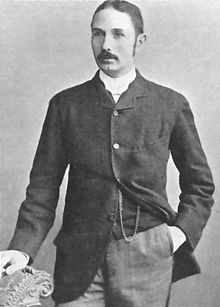 John
and Emma Hartley had seven children – Rosa Mary (1842–1928); George Thompson
(1844–1917); Eleanor Jane (1845–1931); Alice (1847–1931); John Thorneycroft
(1849-1931); Charles Albert (1851-1915); and Emma Constance (1854–1938).
John
and Emma Hartley had seven children – Rosa Mary (1842–1928); George Thompson
(1844–1917); Eleanor Jane (1845–1931); Alice (1847–1931); John Thorneycroft
(1849-1931); Charles Albert (1851-1915); and Emma Constance (1854–1938).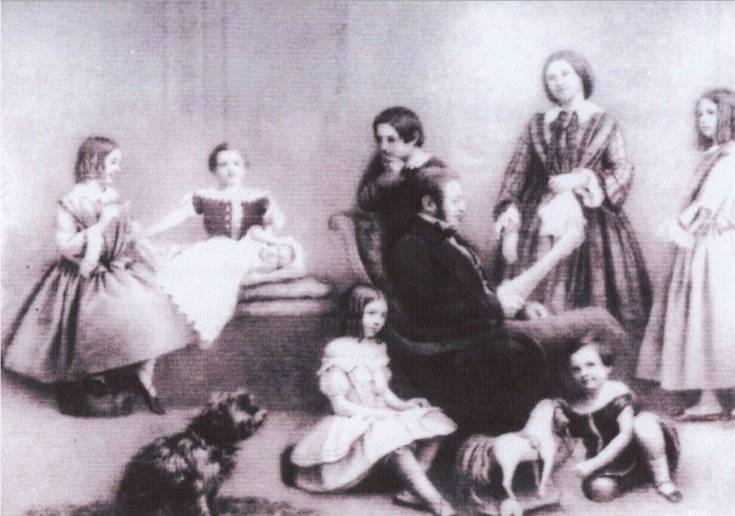
Charles Albert Hartley had met Mary Emmeline Campbell (1863–1942) the second daughter of Colin Minton Campbell of Woodseat Hall, Rocester, when she visited Wolverhampton for a civic occasion. They were married at a grand society wedding at St Michael’s Church, Rocester, on 28th September 1886. A newspaper report of the event stated the village turned out in overwhelming numbers, both church and surroundings filled to capacity.
 On an eminence overlooking Rocester Railway Station and the Dove Valley, just
north of Mince Pie Hall (Banks Farm), a grand mansion sporting over 21 rooms was
erected as a marital home by the Hartley and Campbell families. Apart from the
ground floor, hearths and chimneys which were built with bricks, the upper three
storeys were built entirely of Swedish Pine. It gained the name “The Rookery”,
and it was between The Rookery (built circa 1887) and a large mansion at
Llandudno that Charles Albert Hartley and his bride Mary Emmeline started
married life in 1886.
On an eminence overlooking Rocester Railway Station and the Dove Valley, just
north of Mince Pie Hall (Banks Farm), a grand mansion sporting over 21 rooms was
erected as a marital home by the Hartley and Campbell families. Apart from the
ground floor, hearths and chimneys which were built with bricks, the upper three
storeys were built entirely of Swedish Pine. It gained the name “The Rookery”,
and it was between The Rookery (built circa 1887) and a large mansion at
Llandudno that Charles Albert Hartley and his bride Mary Emmeline started
married life in 1886.
Educated at Harrow, Charles enjoyed sports of all descriptions, especially those connected with horses. He was noted as a welter weight Polo player of some seventeen stone.
Most summers were spent at Llandudno, where Charles Hartley drove for his own amusement a private coach between Dolgellau and Barmouth, and later from Wolverhampton to Bridgnorth. Winters were spent at The Rookery, where Charles and Mary Hartley moved to permanently around 1891 to be near their relations, the Campbell family of Woodseat Hall.
It is commonly believed that from the family coat of arms, Charles Hartley took the Black from the Martlet and Gold from the Cinquefoil as his famous Racing Colours. Sometimes he would run as many as four horses from his stables at The Rookery at Uttoxeter Races and other venues.
 It was some time around the early 1890’s that he sponsored Rocester
Football Club, and purchased the playing strip - with the condition they wore his
racing colours of black and amber stripes. These famous colours remain to the
present day.
It was some time around the early 1890’s that he sponsored Rocester
Football Club, and purchased the playing strip - with the condition they wore his
racing colours of black and amber stripes. These famous colours remain to the
present day.
Charles Albert Hartley died suddenly on 10th September 1915 at The Rookery. Although ailing for some considerable time, a victim of diabetes, he had never put illness before living his life to the full. The death of his only son Charles Campbell Hartley in 1912 was said to have been a mortal blow from which he never really recovered.
Highly esteemed by all in Rocester and district, he had countless friends in all parts of the country. His figure, always conspicuous wherever he went by reason of his huge stature and ample physical proportions. His geniality, old world charm and courtesy attracted a host of friends and acquaintances around him that became the envy of many. He was interred in Rocester Old Church Yard.
Charles Albert Hartley pictured in 1891.